A Loop Inside a Loop
O(n²) means quadratic time: the work grows with the square of the input. Twice the elements, four times the steps. Ten times the elements, a hundred times the steps.
The tell-tale shape in code is a loop inside a loop, both running over the same data. The outer loop runs n times, and for each of those the inner loop runs n times again: n · n steps.
Quadratic is fine for small arrays. For 100,000 elements it is already 10 billion steps — that is where programs start to hang.
All Pairs
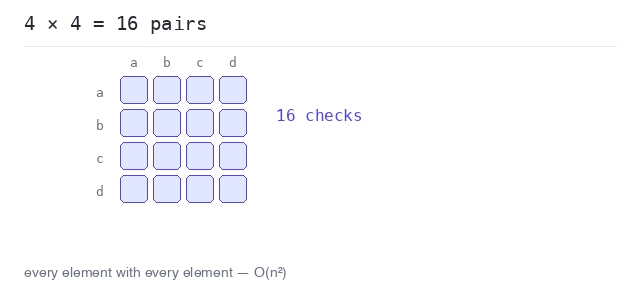
The most direct O(n²) task: combine every element with every element. 4 letters make 4 · 4 = 16 pairs; 100 letters would make 10,000.
Build every pair
The outer loop picks x, the inner loop pairs it with every y. 4 elements produce 16 pairs — the square of the input size.
Output: TypeScript file and captured output
const letters = ["a", "b", "c", "d"]
let pairs = 0

for (const x of letters) {
  const row: string[] = []
  for (const y of letters) {
    row.push(x + y)
    pairs++
  }
  console.log(row.join(" "))
}

console.log(letters.length, "elements made", pairs, "pairs")
Bubble Sort
Bubble sort is the classic quadratic algorithm: it repeatedly walks the array and swaps neighbours that are in the wrong order. Big values "bubble" to the end, one pass at a time.
With its two nested loops it makes about n²/2 comparisons. It is a great algorithm to learn from — and a bad one to use: nums.sort((a, b) => a - b) does the same job in O(n log n).
Sort with two nested loops
Sorting 5 elements takes 4 + 3 + 2 + 1 = 10 comparisons. For 1,000 elements it would be about half a million — while an O(n log n) sort needs about ten thousand.
Output: TypeScript file and captured output

const nums = [5, 3, 8, 1, 4]
let comparisons = 0

for (let i = 0; i < nums.length - 1; i++) {
  for (let j = 0; j < nums.length - 1 - i; j++) {
    comparisons++
    if (nums[j] > nums[j + 1]) {
      const left = nums[j]
      nums[j] = nums[j + 1]
      nums[j + 1] = left
    }
  }
}

console.log("sorted:", nums)
console.log("comparisons:", comparisons)
Duplicates the Slow Way
Checking every element against every element that comes after it is another nested-loop pattern — comparing all pairs to find a duplicate.
It works, but it is O(n²). The Space Complexity page in this group shows the standard trick that makes this linear: remember the values you have already seen in a Map.
Find a duplicate with two loops
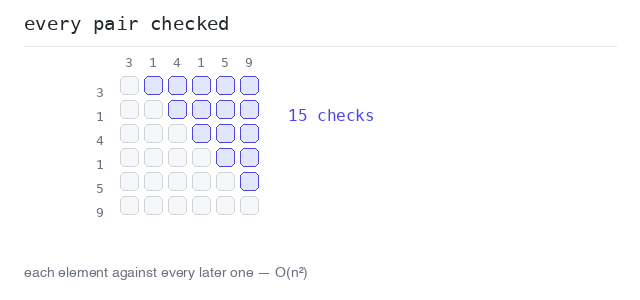
Each element is compared with every later element. The duplicate pair of 1s is found after 7 checks; in the worst case — no duplicate at all — all 15 pair checks run.
Output: TypeScript file and captured output
const nums = [3, 1, 4, 1, 5, 9]
let checks = 0

for (let i = 0; i < nums.length; i++) {
  for (let j = i + 1; j < nums.length; j++) {
    checks++
    if (nums[i] === nums[j]) {
      console.log("duplicate:", nums[i], "after", checks, "checks")
    }
  }
}