What It Is
The Decorator pattern adds behavior to an object by wrapping it in another object with the same interface. Each wrapper does its extra bit and passes the call on to what it wraps.
Because wrapper and wrapped share the interface, wrappers stack in any combination — like layers of clothing.
Example: Wrapping a Notifier
The plain notifier sends an email. One wrapper adds logging before the send; another adds an SMS after it. The caller still sees a plain Notifier.
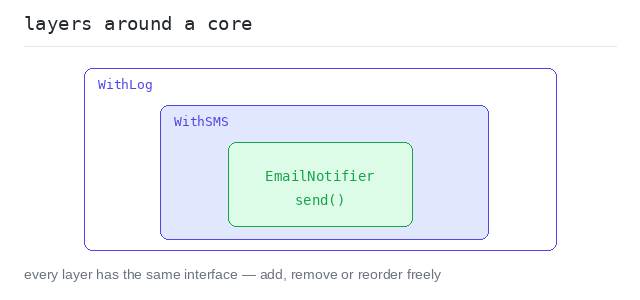
Layers around a core
new WithLog(new WithSMS(new EmailNotifier())) reads inside-out: email at the core, SMS around it, logging outermost. Any layer can be added, removed, or reordered without touching the others.
Output: PHP script
<?php

interface Notifier {
  public function send(string $msg): void;
}

class EmailNotifier implements Notifier {
  public function send(string $msg): void {
    echo "email: ", $msg, "\n";
  }
}

// Each decorator wraps a Notifier and adds one layer.
class WithLog implements Notifier {
  public function __construct(private Notifier $wrapped) {}

  public function send(string $msg): void {
    echo "log: sending a notification\n";
    $this->wrapped->send($msg);
  }
}

class WithSMS implements Notifier {
  public function __construct(private Notifier $wrapped) {}

  public function send(string $msg): void {
    $this->wrapped->send($msg);
    echo "sms: ", $msg, "\n";
  }
}

$n = new WithLog(new WithSMS(new EmailNotifier()));
$n->send("server is down");
When to Use It
Use it to add optional, combinable behavior — logging, caching, retries, metrics — around a core you do not want to modify. HTTP middleware in PHP applications wraps request handlers in exactly this way.
Skip it when the behavior is not optional and not combinable — then it belongs inside the class itself, where it is easier to find.
Pros and Cons
Pros: behavior added without touching the core class; layers combine freely; each layer is small and testable alone.
Cons: a deep stack of wrappers is hard to debug — the call travels far before doing anything; construction lines get long.